How I Became a Female Supremacist
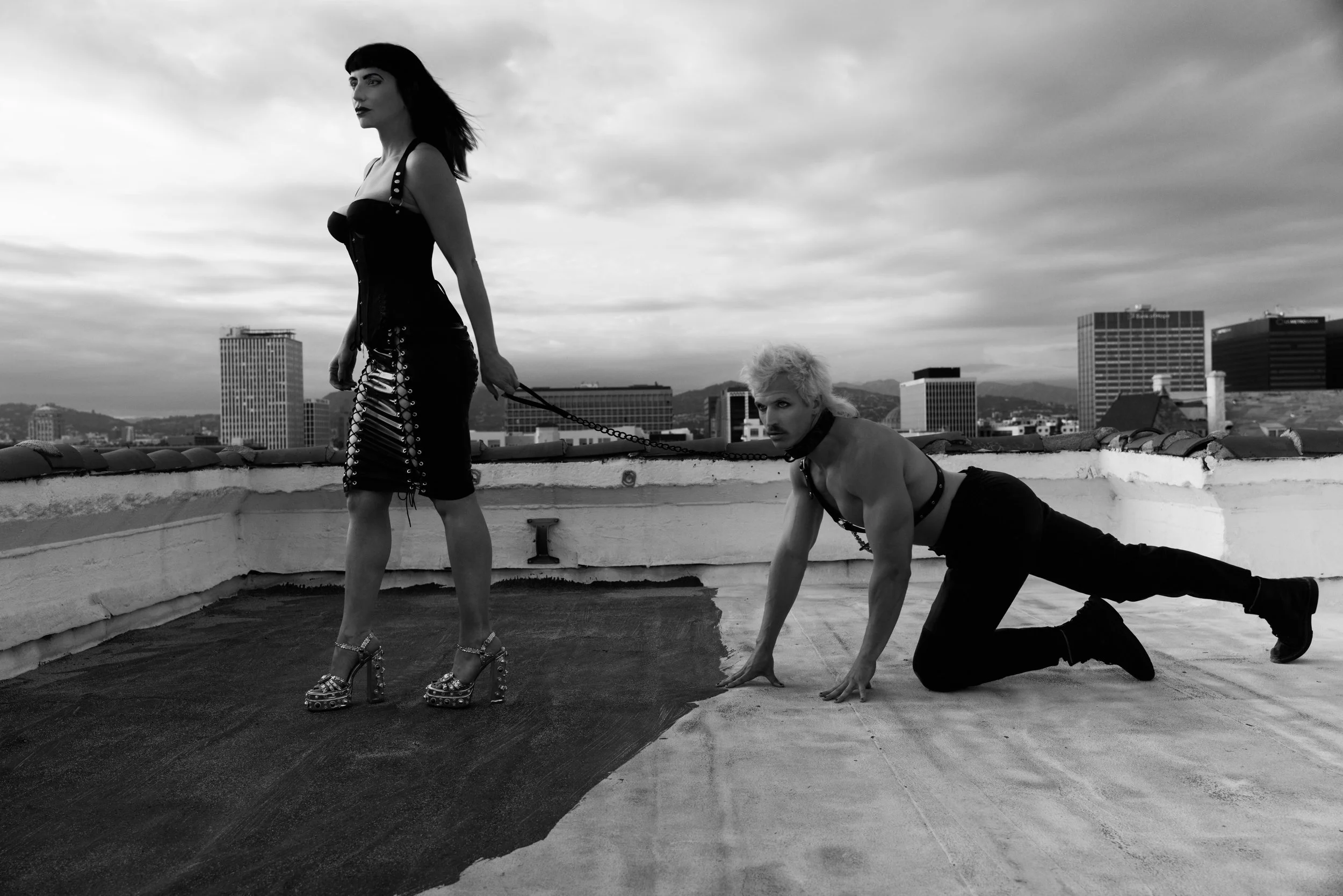
I didn’t arrive at female supremacy because I hate men.
That would have been too easy. And far too predictable based on the abuse I’ve experienced at the hands of my stepfather and my cult.
If I’m anything at all, I’m an iconoclast. Conforming even to psychological norms irks me.
Funny thing what 25 years in a cult will teach you
I arrived at female supremacy because I spent 25 years learning what submission to men actually costs. I tell that story with humor in my novel, Domme & Dommer. Despite my humorous take, being dominated by a group of narcissistic men made me less bitter and more educated as time passed. I was up close to something expertly designed to keep women—even intelligent ones like myself—down. I came to view that experience through an anthropological lens. What a fucking ride.
I came to learn that all systems of abuse, all cults, all narcissistic control groups have basically the same blueprint to subjugate women. And guess what? Ninety-nine percent of the time they’re run by men. No surprise there.
Still, that experience didn’t automatically result in my female supremacy.
Before anyone panics, let me clarify something that people tend to misunderstand…
Female supremacy is nothing like racial supremacy
When I say I’m a female supremacist, I’m not saying men are less human. I don’t believe that. Men are equal as human beings. Equal in dignity, equal in moral worth, equal in their right to live meaningful lives. I believe that at birth all humans are equal. However, what women endure in every corner of this Patriarchal planet is nothing less than endurance training and that adds up to superior qualities.
Women, like other minorities, have no choice but to adapt for survival. We have a fight in us that could only result from 1) our unique biology, and 2) our oppression by men.
We are superior as caretakers. Full stop.
So, equality of worth is not the same thing as equality of stewardship.
The more I study history, anthropology, biology, and my own life as a woman, the harder it became to ignore a pattern: women, as a class, tend to be better caretakers—of themselves, of communities, and of the long-term survival of the species.
That realization didn’t come all at once. It came slowly, through lived experience and a growing body of evidence that made it harder and harder to pretend the differences weren’t there.
The First Teacher: Womanhood Itself
The first place I encountered the idea that women possess a different kind of strength was not in a book. It was in my body.
Women’s lives are structured around biological endurance in ways that men rarely have to contemplate. Menstruation. Hormonal cycles. Pregnancy. Childbirth. Postpartum recovery. The invisible mental load of social and familial caretaking.
Whether or not a woman chooses motherhood, she grows up knowing that her body is built around the possibility of sustaining another life. I learned this in an instant at age 11 during field day when my gut felt like it was being severely rearranged. The blood on my underwear confirmed what felt like a premature truth. From that day forward, I never experienced anything other than disabling pain from my period. So traumatic that I eventually removed the damn womb in Manila. Ahhh, so this is what it feels like to be a man, was my thought the moment I healed and had no more anal cramps, entire days and nights with 800 mg of Ibuprofen every four hours on the dot, even muscle relaxers to try to blunt the violent reality in my core.
There is nothing theoretical about women’s physical suffering. Having a menstrual period requires resilience, patience, and a level of long-term thinking that doesn’t lend itself to impulsive domination. It is stewardship by design. This tormenter lives inside you. And I haven’t even discussed the emotional and psychological toll of PMS or PMDD.
How the fuck are women so tortured and yet so tender? Agents of the Patriarchy, you tell me.
Even women who never reproduce tend to carry that same orientation toward care—toward maintaining social bonds, anticipating needs, and keeping the machinery of daily life running.
In other words: caretaking.
This brilliant scene in Fleabag well illustrates my point.
The Public Health Data Doesn’t Lie
Once I began paying attention, I started noticing something else. The statistical patterns matched what I saw around me.
Across virtually every country on Earth, women live longer than men. According to data compiled by the World Health Organization, women consistently outlive men by several years across almost all populations.
Men also die more frequently from preventable causes: violence, accidents, substance abuse, and untreated health conditions.
This isn’t because men are biologically doomed. Public health researchers repeatedly find that men engage in more risk-taking behaviors and are less likely to seek medical help or preventive care.
If the first responsibility of stewardship is maintaining one’s own life and health, the global data shows a consistent pattern: women perform better at it.
Men need us, not the other way around.
Women Already Run the Hidden Infrastructure of Society
The second pattern I began noticing was social.
Even in societies that loudly proclaim male leadership, the actual maintenance of daily life tends to fall to women.
Women perform the majority of unpaid care work worldwide—raising children, caring for elderly relatives, maintaining family networks, and managing the countless small tasks that keep communities functioning.
According to estimates by the United Nations, women perform roughly three-quarters of the world’s unpaid caregiving labor.
This work is rarely celebrated, but it is structurally essential. Sociologists often refer to it as the “maintenance infrastructure” of society—the quiet labor that holds communities together.
Caretaking is not glamorous. It doesn’t win wars or build monuments.
But it is what allows civilizations to exist in the first place.
Anthropological Clues About Power and Cooperation
Anthropology also complicates the story we’ve been told about male dominance being “natural.”
Rigid patriarchal systems appear relatively recently in human history, emerging alongside agriculture, property inheritance, and resource accumulation roughly ten thousand years ago. Earlier hunter-gatherer societies appear to have been far more egalitarian and cooperative in their organization.
Even among our primate relatives, we see evidence that culture can dramatically shape social outcomes. Research by Stanford neuroendocrinologist Robert Sapolsky famously documented a baboon troop that became significantly less violent after its most aggressive males disappeared. The troop developed a culture of social bonding and reduced aggression that persisted for decades.
The lesson was not that males are inherently violent. It was that social systems reward certain behaviors—and punish others.
Change the system, and behavior changes too.
The Planet as a Final Audit
If stewardship is measured by long-term outcomes, then the state of the planet itself is the final exam.
Industrial civilization—designed and governed overwhelmingly by men—has produced extraordinary technological progress. It has also produced climate change, ecological collapse, and unprecedented resource depletion.
This doesn’t mean men are uniquely destructive. It means the systems built around competition, domination, and extraction have consequences.
Research increasingly suggests that when women participate more fully in environmental governance, policies tend to favor conservation, public health, and long-term sustainability.
Caretaking, once again.
What Female Supremacy Means to Me
By the time I reached this point in my thinking, the phrase female supremacy had started to feel less like a reaction to my trauma and more like an ancient awakening. Hello, goddess worship of our most ancient ancestors!
Women are not morally pure. We are not saints. We are fully capable of cruelty, selfishness, and bad leadership.
But taken as a group, on the whole women possess stronger tendencies toward the qualities that sustain societies over time: resilience, cooperation, long-term planning, and care.
Those are not glamorous traits. They are not the traits most civilizations reward.
But they are the traits that keep the species alive.
So when I say I’m a female supremacist, what I really mean is this: Men and woman are equal as human beings. But if the question is who has demonstrated greater competence in caring for bodies, communities, and the fragile ecosystem that sustains us all—the evidence increasingly points in one direction.
And after thousands of years of pretending otherwise, it’s time we looked at that evidence honestly.